Classless by design
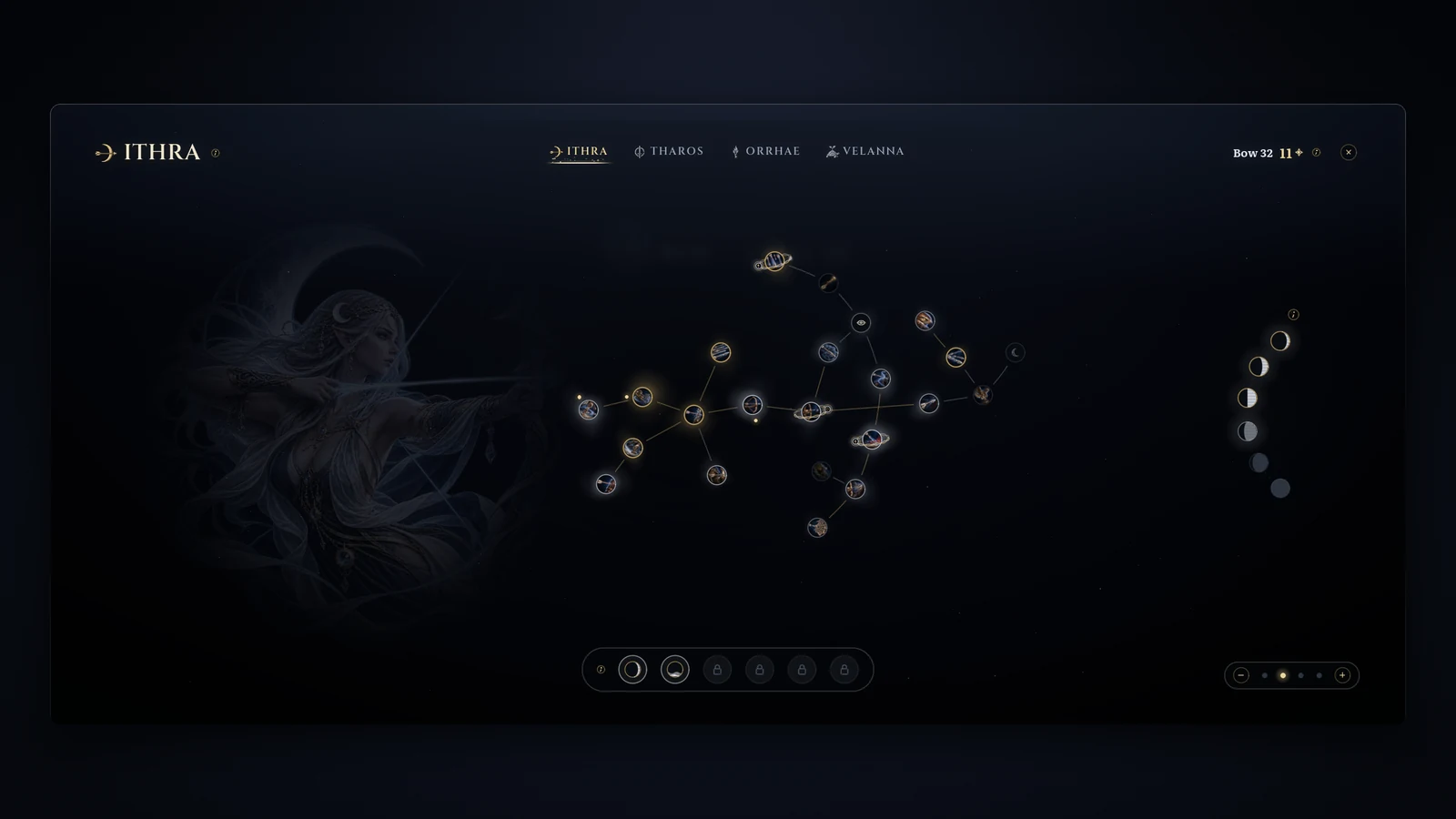
There are no classes in World of Accords. How you fight comes from the weapon you have equipped and the skills you invest in. That's easy to say and hard to build, so here's the structure underneath.
One template for every weapon
Every weapon is a skill tree, and every tree fills the same roles: a filler, a builder, mobility, control, a spender, a defensive, an area skill, a pressure tool for the other range, utility, an execute, a signature and a capstone. A new weapon is complete from day one and fits into everything else automatically.
Using a weapon raises your proficiency with it, which unlocks its skills, their variants and its passives. A variant does its skill's action differently, with a changed shape, range, timing, target count or status, but never a different action. The animation family and your muscle memory stay the same.
One bar, any weapon
Your hotbar takes skills from every weapon you've trained. Press a sword skill with a bow in hand and you draw the sword as you strike. The draw takes a moment, so switching is a decision, not a menu.
Each weapon has its own engine, a resource that builds and spends in its own rhythm: the sword's momentum, the bow's focus, the staff's elemental charges. An engine fades slowly while its weapon is put away, so a swap is part of the rhythm, not a reset.
Passives come from any tree you've unlocked, in a few slots that grow with your level. Weapon passives work only while that weapon is drawn; a few milder ones always do. Specialists win head-on, and hybrids win on options.
The status web
Every weapon applies and exploits one shared list of statuses, and some escalate when applied again: a second snare roots, a second stagger stuns, and a frost hit on a chilled target freezes it. One weapon sets up what another cashes in, and some of a skill's tweaks only unlock through another weapon. A mixed build is meant to be strong, not a compromise.
Control needs limits when fifty players fight fifty. Hard control shares one diminishing meter, interrupts are rate-limited, and each weapon's hard control is capped.
Skills are data
A skill is a row of data, not a class. The staff's sixteen skills run through one data-driven ability that knows how to cast bolts that arc, strikes, lines, novas, cones, placed casts, blinks and wards. Adding a skill is mostly authoring, not engineering.
Responsive, and still the server's call
Every skill is a Gameplay Ability in Unreal's Gameplay Ability System (GAS), set to predict locally. When you press a key, your client starts the skill at once: the opening, the cost, the cooldown and any movement play with no wait. The server runs the same readiness check and decides every hit, every point of damage and every outcome. If it refuses, the client rolls back.
We nearly wrote our own prediction layer. GAS already predicts activation, costs, cooldowns, cosmetic cues and root-motion movement, with rollback built in, so we moved onto Epic's path and only extend it at its seams. We test it at 100 and 200 ms of simulated latency with packet loss, and by having the server refuse presses on purpose to prove the rollback.
Built for a crowd
Our target is fifty players fighting fifty in one place on one server, so combat has budgets: a steady 30 Hz server tick with a hundred combatants in the fight, and a cap on the bandwidth each player receives. Every combat change is reviewed against a few rules:
- One cue per beat. A swing used to send two multicasts; it's now one predicted GameplayCue.
- No reliable RPC per hit, and no replicated timer that ticks.
- Server hit queries are bounded.
- Players keep their ability system on the player state in Mixed replication, as GAS recommends; creatures use Minimal.
Next is a fifty v fifty harness: server-driven bots as full players, measured for server frame time and bytes per connection. Each of Unreal's replication levers, the push model and then Iris, goes in only if that harness shows it pays.
Written in the stars
Your skills are laid out as constellations, in the sky of the god who answers them. The bow belongs to Ithra, the Unerring, god of the hunt, and her greatest shots carry her spirit hawk along with the arrow.
Tell us
If you've played classless games, what made switching weapons feel good, and what made it a chore? Write to us at hello@worldofaccords.com.
‹ All news